Learn · Cognitive Trace
From "I lost" to "here's what I told myself before I clicked."
The Cognitive Trace is the self-coaching framework at the heart of disciplina.'s Day Review. It separates what happened in the market from what was happening in your head — and turns a loss from a P&L number into a lesson with a root cause.
What was happening in the market and in the trade at the moment of the decision.
The internal narrative running underneath the decision — what you told yourself to justify the click.
What resulted — behaviorally, financially, and emotionally — from acting on that self-talk.
The method
Drawn from Brett Steenbarger's cognitive-behavioral methodology.
Brett Steenbarger spent decades working with professional traders — at hedge funds, prop firms, and trading desks — applying cognitive-behavioral psychology to performance improvement. His central insight: the biggest leak in a trader's account is rarely strategy. It's the thought patterns that activate under pressure and override the plan.
Cognitive-behavioral therapy works by identifying the link between a triggering situation, the automatic thoughts it generates, and the behavioral consequences that follow. Steenbarger adapted this framework specifically for trading: the market provides the situation, the trader's internal narrative is the self-talk, and the trade is the consequence.
disciplina. implements this as a structured three-column journaling tool — the Cognitive Trace — available in every Day Review. It can be completed in two minutes for a quick note, or used for a deep examination of a single Standout Trade.
Steenbarger's work is the primary research foundation for disciplina.'s coaching methodology. The Cognitive Trace, the AI Recap's coaching voices, and the Focus Callback mechanism are all drawn from his solution-focused, pattern-of-patterns approach to trader development.
The three columns
What each column asks you to find.
The objective facts of what was happening — in the market, in your account, and in the trade — at the moment you made the decision.
Not your interpretation. Not your feelings. Just: what was on the screen, what was the price, what had just happened.
Separating the situation from the self-talk is the first move in cognitive-behavioral work. Most traders replay events as a single narrative — 'the stock ran and I held because...' — which fuses the external fact with the internal interpretation. The Cognitive Trace forces them apart.
"Market was highly aggressive. Large volume from 4:00 AM pre-market. I had already traded the open and was in a position that was moving in my direction."
The internal narrative that was running underneath the decision — what you told yourself in the moment to justify staying in, getting out, adding size, or ignoring the plan.
Not what you know in retrospect was true. What you actually said to yourself at the time — including the things that now sound uncomfortable.
This is where Steenbarger's framework does its most important work. The self-talk is the mechanism that converts a market situation into a trading behavior. If you can identify it, you can interrupt it. If you can't name it, you can't change it.
"My P&L was a roller coaster. I wasn't happy with how it was playing out — it felt too close to ending the day red. I told myself I needed to stay in to make it back to a satisfying number."
What resulted from acting on that self-talk — the behavioral outcome (what you did), the financial outcome (P&L impact), and the emotional state afterward.
Not a post-hoc rationalization of why it worked out. The full consequence: including the risk you accepted, the rules you broke, and how you felt when the session ended.
The consequences column completes the loop. It connects the self-talk to the real-world cost — making visible the pattern: this specific thought, in this specific situation, reliably produces this specific outcome. Once that pattern is named, it can be interrupted before it fires.
"The day ended green with a $300+ return, but the execution had terrible risk-to-reward in the after-hours trade. I let stops widen and chased price — microscopic reward for massive risk. A green day hiding a behavior problem."
In practice
A real Cognitive Trace, as it looks inside disciplina.
The session ended green $300+ on the day. But the Cognitive Trace exposed what the P&L hid: bad risk-to-reward in the after-hours trade, and a behavior pattern worth addressing before the next session.
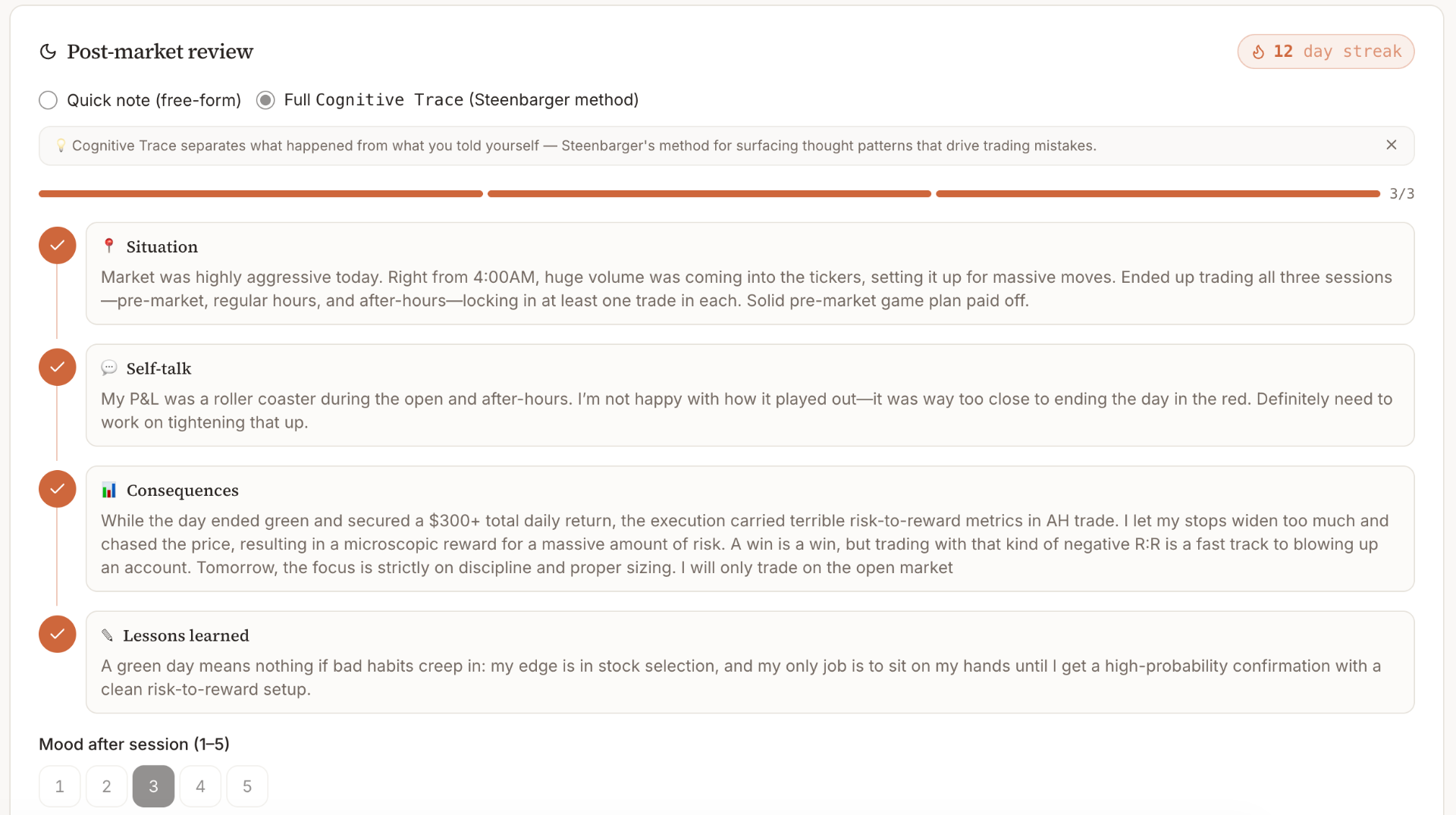
Market was highly aggressive — large volume from 4:00 AM pre-market, with significant moves in the tickers I was watching. Ended up trading all three sessions: pre-market, regular hours, and after-hours, locking in at least one trade in each.
My P&L was a roller coaster during the open and after-hours. I wasn't happy with how it played out — it felt way too close to ending the day red. I told myself I needed to stay active, find another trade, and push the P&L to a number that felt satisfying.
The day ended green with $300+ total daily return. But the execution in the after-hours trade had terrible risk-to-reward: I let stops widen too much and chased price, resulting in a microscopic reward for a massive amount of risk. A win on the scoreboard. A behavior problem in the data.
A green day means nothing if bad habits creep in. My edge is in stock selection and waiting for high-probability confirmation with a clean risk-to-reward setup. The P&L hid what the Cognitive Trace made visible.
Why it works
The difference between reviewing trades and actually changing behavior.
It separates fact from interpretation
Most post-session reviews conflate what happened in the market with what the trader was thinking. The Cognitive Trace forces them apart. The Situation column is restricted to observable facts. The Self-talk column is where interpretation lives. The separation is the insight.
It names the pattern, not just the mistake
A P&L review tells you a loss happened. The Cognitive Trace tells you which self-talk produced it. Once the self-talk is named — 'I need to make it back', 'this has to reverse', 'I can't close this now' — it becomes recognizable the next time it fires. Recognition is the first step toward interruption.
It makes winning sessions as valuable as losing ones
The most dangerous session is the one where bad process produced a good outcome. The Cognitive Trace surfaces behavior problems that P&L hides. A green day with dangerous self-talk is a warning, not a victory — and the Trace makes that visible before the behavior is reinforced.
It builds a personal dataset
Over weeks and months, the Cognitive Trace entries in disciplina. form a record of the specific self-talk patterns that appear under pressure. The AI Recap's Steenbarger voice style reads that record, quotes the language back, and asks the question that interrupts the loop. The trace is the raw material for the coaching.
FAQ
Common questions
What is the Cognitive Trace?
The Cognitive Trace is a three-column self-coaching framework used in disciplina.'s Day Review. It structures post-session reflection around three questions: What was the situation? What was my self-talk? What were the consequences? It is drawn from Brett Steenbarger's cognitive-behavioral methodology for trader performance improvement.
What is the difference between the Cognitive Trace and a normal trading journal?
A normal trading journal records what happened — entry, exit, P&L, notes. The Cognitive Trace records why it happened at the level of internal thought process. The key column is Self-talk: the narrative you told yourself in the moment that led to the decision. Most journals don't ask for this at all, which means they can identify patterns in price action but not patterns in the trader's own thinking.
Who is Brett Steenbarger and why does disciplina. use his methodology?
Brett Steenbarger is a clinical psychologist and trading performance coach who has worked with traders at hedge funds and prop firms. He authored The Daily Trading Coach, Trading Psychology 2.0, and Positive Trading Psychology. His work applies cognitive-behavioral and solution-focused psychological methods to trading performance. disciplina. uses his framework because it is one of the few approaches to trading psychology built on rigorous psychological research rather than motivational frameworks.
Do I need to complete all three columns every day?
No. disciplina. offers two modes: a quick free-form note for sessions that don't require deep examination, and the full Cognitive Trace for sessions worth examining in depth. The Standout Trade selector helps identify which trade most deserves the full trace. The goal is sustainable reflection — not a journaling chore that gets abandoned by Friday.
How does the Cognitive Trace connect to the AI Recap?
The AI Recap's coaching voice reads your session's self-talk entries looking for specific language patterns — phrases like 'I need to make it back', 'this has to reverse', 'I can't afford to close here', or 'I deserve a win today'. When it finds them, it quotes them back and asks a single question designed to interrupt the pattern. The Cognitive Trace entries are the raw material that makes the voice's coaching specific rather than generic.
disciplina.
The work is yours. The Cognitive Trace just makes sure you can't look away.
Every session generates a Cognitive Trace entry in disciplina. Over time, those entries become a personal dataset of your thought patterns under pressure — and the foundation for the coaching that changes them.
Request beta access →